- +91 9898445164
-



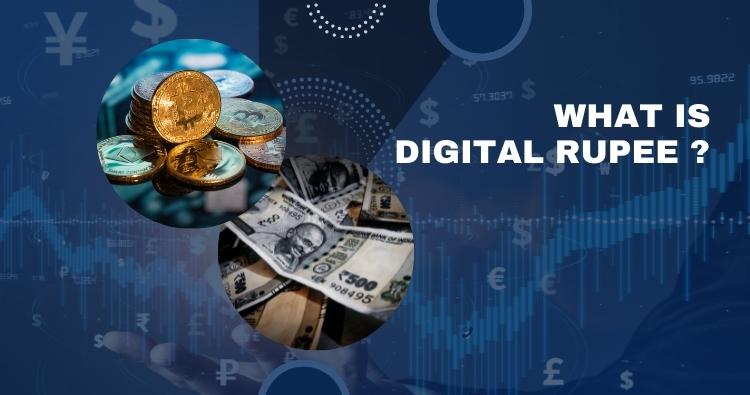
What Is Digital Rupee?
The demand for private cryptocurrency has witnessed tremendous demand in the last few years. Many illegal activities and money laundering have taken place through private cryptocurrency transactions. And the government of India sees the mushrooming of these private cryptocurrencies as a threat to the formal financial system.
To tackle these issues and more, the Indian government has clearly mentioned that cryptocurrencies will never be legal tender. In this year's budget, the finance minister announced RBI would launch a digital rupee that will work on blockchain and act as a legal tender.
This article will talk about the digital rupee and how it differs from other cryptocurrencies.
Countries around the world are planning to launch their cryptocurrency. The cryptocurrency that a country's central bank launches is the Central Bank Digital Currency or CBDC.
The digital rupee, when introduced, would be India’s CBDC.
Digital rupee, as the word sounds, will be the digital version of the rupee. Currently, the Indian currency is available as paper notes and coins. After introducing the digital rupee, the digital rupee will be another form of Indian currency. So, people can exchange a paper note of Rs.100 for Rs.100 for the digital rupee.
The Reserve Bank of India will issue the digital rupee, and the central bank will decide on the supply of the digital rupee just like it does for regular paper currency.
Benefits of Digital Rupee
The government and experts believe that the digital rupee will bring about a change in payments and make digital transactions faster and safer.
Move towards a cashless economy: Compared to other developed countries, cash is widely prevalent in India. There is a cost associated with paper currency, such as printing, storing and transportation. It is estimated that the cost of a paper note is 17% of the value of the paper note. Moreover, the paper notes don't last forever, and new paper notes have to replace soiled paper notes.
The introduction of the digital rupee may reduce our dependence on paper notes. The government may end up saving money in this way.
The introduction of the digital rupee may be the first step towards an ultimately cash-free India.
Prevent money laundering and illegal activities
Many money laundering and illicit activities are currently taking place through cash and private cryptocurrencies. The anonymity of cash and private cryptos lets people continue with the dealings without getting caught. But, as the digital rupee will be in the digital format, the government may be able to track each rupee. The wide adoption of the digital rupee may make it harder for people to carry out money laundering and other illegal activities.
Difference between the digital rupee and digital transactions
One of the key differences between the digital rupee and digital transactions like UPI and net banking is the underlying technology. CBDCs use distributed ledger technology (DLT), often combined with traditional central bank and payment infrastructure in a hybrid architecture.
Moreover, an intermediary, such as a bank or a platform like Google Pay, is needed to carry out digital transactions. However, in the case of the digital rupee, the RBI can directly issue a digital rupee through a new platform without the help of a bank or another company.
UPI payments are now made with the digital equivalents of current cash notes. This means that every rupee sent via UPI is backed by paper currency.
Difference between the digital rupee and private cryptocurrency
The digital rupee or any other central bank digital currency (CBDC) isn’t a cryptocurrency in the truest sense.
A CBDC will be created and stored in a more centralised manner than other cryptocurrencies, which are stored on a decentralised blockchain network.
This means that the digital rupee can be monitored and regulated, unlike a private cryptocurrency. Your personal information will be 'linked' to your CBDC and may be subject to examination and regulation by the authorities.
Conclusion
While the RBI may come out with the digital rupee in the financial year 2022-23, it may go through a series of trials before the citizens at large can actually access the digital rupee.
It would be interesting to follow the developments of the digital rupee.
This blog is purely for educational purposes and not to be treated as personal advice. Mutual fund investments are subject to market risks, read all scheme-related documents carefully.
VALSAD OFFICE
"Millenium",1st floor,
Office No 103, Opp. Pragji Tower,
Halar Road ,Valsad -396 001
Mail us :
primeinvestmentsc@gmail.com
+91 9898445164
+91 8140070888
.png)


.png)
Risk Factors –Mutual Fund investments are subject to market risks. Read all scheme-related documents carefully. Investments in securities market are subject to market risks; read all the related documents carefully before investing. Mutual fund schemes do not offer guaranteed or assured returns; past performance is not indicative of future returns. We provide execution-only services with incidental advice in Regular Plans of mutual funds and receive commission from AMCs. We are not a SEBI-registered Investment Adviser; for personalised investment advice, consult a SEBI-registered Investment Adviser. Insurance is the subject matter of solicitation. Please read the sales brochure / policy document carefully before concluding a sale.
Pragnesh S Desai (Prime Investment Services)
AMFI-Registered Mutual Fund Distributor
ARN-36435 (Valid up to 23-Jul-2028)
Insurance Agency Code:
General Insurance Code: IFFCO Tokio General Insurance Co. Ltd. – ITGZRI00108
Health Insurance Code: Star Health & Allied Insurance Co. Ltd. – SHABA0000023886
Life Insurance Code: ICICI Prudential Life Insurance – ICI01741859
Grievance Officer- Mr. Pragnesh S Desai | +91 98984 45164 | primeinvestmentsc@gmail.com | SEBI SCORES: https://scores.sebi.gov.in/ | SMART ODR: https://smartodr.in/
© Prime Investment Services. All rights reserved. Important Links | Disclaimer | Commission Disclosure | Privacy Policy | Terms of Use| SID/SAI/KIM | Code of Conduct | SEBI Circulars | Investor Grievance Redressal Policy | AMFI Risk Factors